

Trump Child Savings Accounts Imitate And Innovate

Carrie Brandon Elliot, Contributor
March 9, 2026
According to an official U.S. government website , “Trump Accounts Jumpstart the American Dream.” In a press release, Treasury called them “the defining policy of America’s 250th anniversary.” But how revolutionary are Trump accounts?
Child savings accounts have precedent in the United States as well as other countries. They typically have favorable tax treatment and are sometimes partly funded by government contributions. Tax-favored accounts for education expenses are not unusual — the United States, Canada, and other countries offer them. General-purpose child savings accounts, from which the beneficiary receives the funds at adulthood and can use them for any purpose, are more unusual but are offered by multiple countries. Child savings accounts earmarked for retirement purposes, like Trump accounts, are relatively rare.
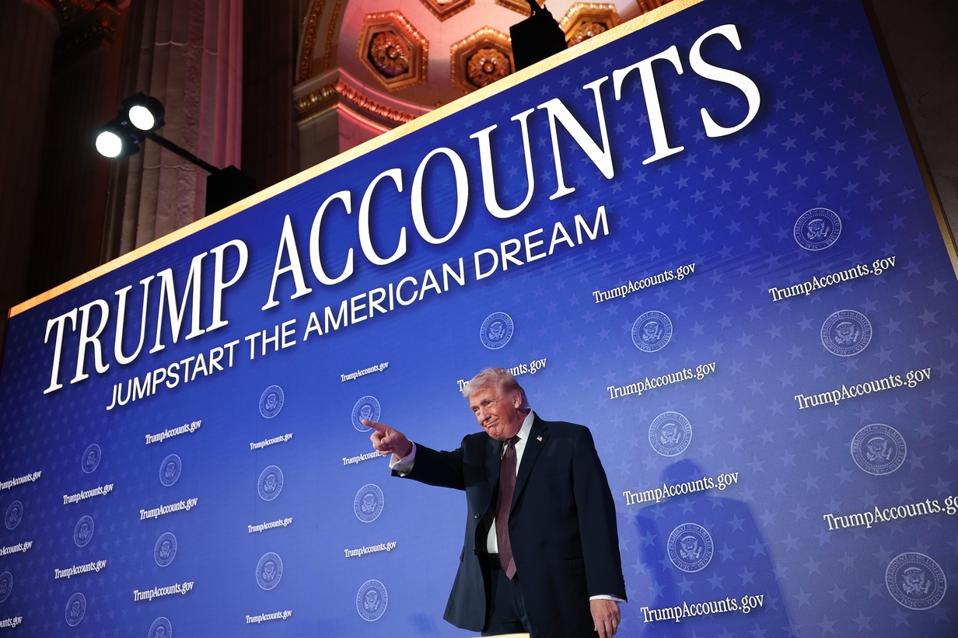
WASHINGTON, DC – JANUARY 28: U.S. President Donald Trump arrives on stage before delivering remarks during the Treasury Department’s Trump Accounts Summit at Andrew W. Mellon Auditorium on January 28, 2026 in Washington, DC. (Photo by Win McNamee/Getty Images)
Getty Images
Regardless of whether the savings are dedicated to a general purpose, education, or retirement, uniform policy elements arguably increase participation, operational efficiency, and financial returns. The Trump accounts have some, but not all, of those policy elements.
Trump Accounts
Section 70204 of the One Big Beautiful Bill Act ( P.L. 119-21 ) added sections 530A , 6434 , and 128 to the code (earlier versions of section 128 were repealed or redesignated to section 140 ). Section 530A establishes Trump accounts, section 6434 introduces a $1,000 government contribution pilot program, and section 128 allows an employer to deduct contributions to an employee’s child’s Trump account.
Notice 2025-68, 2025-52 IRB 856, released December 2, 2025, provides a useful summary of how the new provisions work together. A Trump account is a traditional IRA established for an eligible individual and designated as a Trump account. The eligible individual is the owner of the Trump account and its beneficiary.
A Trump account is subject to rules that don’t apply to other IRAs during the growth period, which begins when the account is established and ends before January 1 of the calendar year during which the beneficiary reaches age 18. For example, a child born on October 1, 2025, will turn 18 on October 1, 2043, meaning the last day of the growth period is December 31, 2042.
During the growth period:
- funds in a Trump account can be invested only in eligible investments;
- a Trump account has a separate contribution limit from other retirement arrangements;
- a Trump account is generally not allowed to make distributions; no retirement savings deduction is allowed under section 219 for any contribution to a Trump account; and
- trustees of Trump accounts have similar but different reporting requirements from trustees of other IRAs.
After the growth period, most of these special rules no longer apply, and the rules in section 408 governing traditional IRAs generally apply.
Establishment . A Trump account is established to benefit an eligible individual, defined as an individual for whom an election is made to establish a Trump account, who will not attain age 18 before the close of the calendar year in which the election is made, and for whom a Social Security number has been issued before the date of the election. The Treasury secretary will create or organize the initial Trump accounts.
During the growth period, a later rollover Trump account may be established for an individual and funded by a trustee-to-trustee transfer of the entire account balance of an existing Trump account in a qualified rollover contribution.
Contribution Pilot Program . Under a pilot program election in section 6434 , $1,000 is paid by the Treasury secretary into the Trump account of an eligible child. An eligible child is an individual born after December 31, 2024, and before January 1, 2029 (during calendar years 2025-2028); is a U.S. citizen; has an SSN included with the election; and is an individual for whom no prior pilot program election has been made.
Contributions . Contributions to Trump accounts cannot be made before July 4, 2026. Contributions during the growth period are not includible in income by the beneficiary when made. There are five types of contributions that can be made to a Trump account during the growth period:
(1) the pilot program contribution from the Treasury secretary of $1,000;
(2) qualified general contributions funded by federal, state, local, or Indian tribal governments and section 501(c)(3) tax-exempt organizations;
(3) employer contributions that are not includible in the gross income of the employee under section 128 ;
(4) qualified rollover contributions (from an initial Trump account to a rollover Trump account); and
(5) contributions from other sources (like the beneficiary, parents, or any other person).
Pilot program contributions, qualified general contributions, and section 128 employer contributions do not create basis in a Trump account. Qualified rollover contributions are transfers from an earlier Trump account and carry over any basis attributable to the funds being transferred. Contributions from other sources during the growth period also create basis in the Trump account.
Unlike contributions to IRAs (which require the IRA owner to have includible compensation), contributions may be made to a Trump account during the growth period even if the beneficiary does not have includible compensation.
Pilot program contributions, qualified general contributions, and qualified rollover contributions do not have an annual limit. However, all other contributions (from employers and other sources) during the growth period are subject to an aggregate annual limit of $5,000 (plus cost of living adjustments after 2027).

13 June 2022, Baden-Wuerttemberg, Rottweil: The logo of the American S&P 500 Index can be seen on the monitor of a computer in an office. Photo: Silas Stein/ (Photo by Silas Stein/picture alliance via Getty Images)
Eligible Investments . During the growth period, funds in a Trump account may be invested only in eligible investments — generally a mutual fund or exchange-traded fund that tracks an index of primarily U.S. companies, like the S&P 500 stock market index. An eligible investment does not use leverage or have annual expenses greater than 0.1 percent of the fund balance. It also must meet other criteria that the secretary deems appropriate.
Distributions . During the growth period, no distributions may be made from a Trump account except for qualified rollover contributions, qualified rollover contributions to accounts under the Achieving a Better Life Experience Act (ABLE accounts), distributions of excess contributions, and distributions upon death of the beneficiary.
After the growth period, distributions from a Trump account generally are subject to the rules that apply to distributions from a traditional IRA. This includes the section 72(t) 10 percent additional tax on early distributions if an exception does not apply (like distributions for qualified higher education expenses, first home purchases, or after age 59½).
Reporting . During the growth period, Trump accounts are not subject to the IRA reporting requirements of section 408(i) . Instead, they are subject to reporting requirements under section 530A(i) , which are similar to those for IRAs under section 408(i) . After the growth period, the reporting requirements in section 408(i) apply to the Trump account. A Trump account is never subject to reporting under both sections 408(i) and 530A(i) .
Coordination With IRA Rules . After the growth period, nearly all the special rules for Trump accounts (including those for contributions, investments, distributions, and trustee reporting) cease to apply. At that time, Trump accounts generally will be subject to the section 408 rules that apply to other traditional IRAs (like those for contributions, distributions, required minimum distributions, rollovers, Roth conversions, ordinary income taxation, and reporting).
However, a Trump account will continue to be a Trump account after the growth period. An account initially established as a Trump account can never receive contributions under a section 408(k) simplified employee pension arrangement or section 408(p) SIMPLE IRA plan. It can never be aggregated with other individual retirement arrangements when allocating basis related to a distribution from either the Trump account or another individual retirement arrangement.
Employer Contribution Limit . Section 128 employer contributions to a Trump account are limited to $2,500 per year, plus cost of living adjustments after 2027. Section 128 employer contributions must be made under a section 128(c) Trump account contribution program, which is an employer’s written plan to provide contributions to Trump accounts that meets requirements similar to those of a dependent care assistance program under section 129(d)(2) , (3) , (6) , (7) , and (8) (regarding discrimination, eligibility, notification, statements, and benefits).
Qualified ABLE Rollover Contribution . This is a contribution made during the calendar year in which the beneficiary turns age 17 in a direct trustee-to-trustee transfer of the entire balance of a Trump account to an ABLE account (as defined in section 529A(e)(6) ). Contributions to ABLE accounts are made on an after-tax basis, and earnings are tax deferred and tax free if used for qualified disability expenses.
Section 529 Accounts
According to the IRS website , a qualified tuition program (QTP), also referred to as a section 529 plan, is a program established and maintained by a state, or an agency or instrumentality of a state, that allows a contributor either to prepay a beneficiary’s qualified higher education expenses at an eligible education institution or to contribute to an account for paying those expenses. Contributions are not tax deductible.
Qualified higher education expenses in connection with enrollment or attendance at an elementary or secondary school are limited to $20,000 per year ($10,000 before Dec. 31, 2025).
QTP Benefits . Earnings accumulate tax free while in the QTP account. Distributions are not taxable when used to pay for qualified higher education expenses. However, if the amount of a distribution is greater than the beneficiary’s qualified higher education expenses, a portion of the earnings is taxable.
Rollover to a Roth IRA . The beneficiary of a QTP account is permitted a special rollover distribution from their account to their Roth IRA. For this special rollover to be tax free, the rollover amount must be paid through a direct trustee-to-trustee transfer, be subject to the Roth IRA annual contribution limit and a $35,000 lifetime limit, be distributed from a QTP account that has been open for at least 15 years as of the date of the distribution, and not exceed the amount contributed to the QTP (and attributable earnings) before the five-year period ending on the date of the distribution.
Foreign Child Savings Accounts
There is precedent in some countries for establishing accounts that belong to children to which governments contribute seed money. The accounts belong to the child, are managed by parents or guardians, and may be withdrawn by a minimum age for a specific purpose or general use. Trump accounts are relatively unique in that they are earmarked for retirement.
Canada . Canada’s Registered Education Savings Plan (RESP) helps people save for a child’s education after high school. The Canadian government contributes to RESPs through grants and bonds. Eligible expenses include tuition, books, tools, transportation, and rent. The Canada Education Savings Grant matches 20 percent of the first $2,500 of annual contributions, up to $500 per year. Low- to middle-income families may receive an extra 10 percent or 20 percent education savings grant on the first $500 of annual contributions.
Low-income families are also eligible for the Canada Learning Bond, under which the government provides an initial $500, plus $100 for each year of eligibility (up to age 15), totaling up to $2,000, with no personal contributions required. Grants are generally available until the end of the calendar year in which the child turns 17. If the child does not pursue post-secondary education, government grants must be returned.
Beginning in April 2028, the government of Canada will automatically open a RESP to deposit the learning bond for children who were born in 2024 or later, have a valid Social Insurance Number, are not already named as a beneficiary of a RESP by age 4, and whose family income is at or below the specified income threshold for this benefit. To be eligible for automatic enrollment, a child’s primary caregiver must also have filed income tax returns and be eligible to receive the Canada Child Benefit. Starting in 2027, parents and caregivers may opt out of automatic enrollment.
If the RESP is used for education, the money earns interest tax free while in the RESP, contributors do not get a tax deduction, and investment earnings in the RESP will not be taxed until money is taken out to pay for the child’s education. If the RESP is not used for education, contributors will not be taxed on the amounts contributed to the RESP but will have to pay taxes on the money earned as interest at the regular income tax level, plus an additional 20 percent (12 percent for Quebec). The contributions are returned to the contributor in that case.
Several countries have child savings programs that are designed for long-term wealth building rather than education or retirement. Like the section 530A account, which acts as a starter retirement account or custodial IRA for children, these programs often feature government seed money and funds that cannot be accessed until adulthood.
General-purpose child savings accounts are available in Hungary, Israel, Singapore, Taiwan, and the United Kingdom (as opposed to education-related accounts like those under section 529 or retirement-related accounts like those under section 530A ).
Hungary . Under Hungary’s Baby Bond program for children born after 2005, the government contributes a tax-free deposit of approximately $185 into a special account. Parents may contribute to the account, and the total balance (including interest) is available for the child to use freely upon turning age 18. The bonds pay a 3 percent premium over inflation and the government offers a 10 percent top-up for additional purchases.
Israel . Israel’s Savings for Every Child Program started in 2017. The government makes monthly deposits into a bank account or provident fund for every child until they turn 18. Parents can choose to match these deposits. The funds are not restricted to education and can be withdrawn as a lump sum at age 18 or 21 to help with any life expense.
Singapore . Singapore has four national programs to build assets for children: the Baby Bonus Child Development Account, the Edusave Account, the Post-Secondary Education Account, and the MediSave Grant for Newborns. These include an education-specific account and a cash gift for newborns deposited directly into a parent’s bank account.
Taiwan . The Taiwanese government contributes to child savings accounts through the Children and Teenagers Education and Development Account program initiated in 2017. The government provides a dollar-for-dollar matching contribution for savings deposited by families up to a maximum of TWD 15,000 per year for eligible children. Funds are generally intended for higher education, vocational training, or entrepreneurship, and they can be withdrawn upon reaching age 18.
Announced in December 2025, a draft Taiwan Future Account plan proposes that the government set up a universal special investment account for children age 12 or younger that can only be claimed after they turn 18 years old. The account would have an initial deposit of TWD 50,000 ($1,581) for each child with a valid household registration, with TWD 10,000 added every year up to the age of 12. Its savings would be invested in index funds on Taiwan’s stock market.
United Kingdom . Under the Child Trust Fund (CTF) program, the government provided seed money of up to £500 for children born between 2002 and 2011. Although the CTF program was discontinued for new births in 2011, millions of these accounts still exist. Like the section 530A account, the money is inaccessible until the child turns 18, at which point it can be used for any purpose, like a home deposit or starting a business.
The United Kingdom’s Junior Individual Savings Account (ISA) program was introduced November 1, 2011, to replace the CTF. It allows parents and guardians to save tax efficiently for children born on or after January 3, 2011, or for those without a CTF. In the 2025-2026 tax year, the savings limit for Junior ISAs is £9,000. To qualify, a child must be under 18 and live in the United Kingdom.
Parents may not open both a Junior ISA and a CTF for a child. Parents who want to open a Junior ISA must ask the provider to transfer the CTF into it. Junior ISA providers include banks, building societies, credit unions, friendly societies, and stockbrokers.
Parents may choose a cash Junior ISA, in which interest on the cash saved is tax free, or a stocks and shares Junior ISA, in which cash is invested and capital growth or dividends received are tax free. A child may have one or both types.
Parents or guardians with parental responsibility can open a Junior ISA and manage the account, but the money belongs to the child. The child may take control of the account at age 16 but may not withdraw the money until age 18, although there are exceptions. Anyone can contribute money to a Junior ISA, but the total contribution cannot exceed £9,000 in the 2025-2026 tax year.
These programs all offer a mixture of incentives for saving that include government deposits and matches, curtailed investment options, deferred taxes, and limited withdrawals. To the extent that participation levels and operational efficiency varies, however, they are not all created equal. As explained below, better outcomes are linked to an assortment of policy elements.
Policy Elements
In August 2021, the Russell Sage Foundation published a study evaluating state-level child development accounts (CDAs), which it described as investment accounts offering financial access, subsidies, and incentives to provide assets for children. The study identified 10 design elements that tend to increase the likelihood that a policy will be universal, progressive, lifelong, efficient, scalable, and stable. These elements are described below.
Universal Eligibility : All children within a jurisdiction are eligible for CDAs under that jurisdiction’s policy. For a state or city CDA policy, all children in families across the full socioeconomic and geographic spectrum in the jurisdiction are eligible for the CDA. A national CDA policy includes all children in the country; Trump accounts generally have this design element.
Automatic Enrollment : Children are automatically enrolled in the CDA on an opt-out basis. Trump accounts do not have this policy element.
Automatic Initial Deposit : All children automatically receive a substantial initial deposit ($500 to $1,000) when enrolled. This is true of pilot program contributions to Trump accounts for children born during calendar years 2025-2028.

getty
Start at Birth : State birth records enable CDA administrators to enroll beneficiaries when they are born, which maximizes the potential for asset growth. These records also facilitate automatic, universal enrollment. Trump accounts may be opened as soon as parents procure an SSN for their child, but automatic enrollment is not a feature.
Automatic Progressive Subsidy : Low-income and disadvantaged children automatically receive additional deposits to boost asset accumulation. This is not a feature of Trump accounts.
Centralized Savings Plan : Through a single, central platform, state-contracted organizations manage CDAs and investments. In the United States, state section 529 plans have served this function, facilitating statewide partnerships, efficiency, and economies of scale. As an existing financial platform in 49 states, section 529 plans have important features well suited to CDAs, including state sponsorship to enable full inclusion and smooth policy operation, legal and accounting structures to facilitate asset accumulation (like savings protection, account restrictions, and tax reporting), centralized administration for accounting and recordkeeping functions, and simplified investment opportunities for potential growth. This policy element may build out over time as the Trump administration identifies trustees and eligible investments.
Investment Growth Potential : To leverage opportunities afforded by long-term market appreciation, CDA deposits are held in funds that have the potential for investment growth over time. Trump accounts will be invested for growth over time.
Targeted Investment Options : Targeted options streamline the CDA program’s investments. One of the most effective ways to simplify program investments and family decision-making is to use age-based funds, which are tailored to the beneficiary’s age and adjust investment allocations to become more conservative as the beneficiary nears the age at which they may withdraw funds. Age-based options simplify fund selection at enrollment and eliminate pressure to make ongoing investment decisions. They also provide a strategic alternative to fixed interest funds. Trump accounts will be targeted to eligible investments that may evolve over time to include age-based funds.
Restricted Withdrawals : Assets are restricted to ensure that withdrawn funds are used only for approved purposes. This is a feature of Trump accounts because the funds are unavailable until a beneficiary turns 18, at which point the accounts have the same withdrawal restrictions as an IRA.
Means Test Exclusion : Governments prohibit public programs from considering CDA funds when determining eligibility for means-tested benefits. Treasury should explicitly clarify that Trump accounts, including supplemental contributions from states and tax-exempt entities, are not included in the means test for public benefit eligibility.
The foundation notes that each of these 10 elements serves multiple policy goals. Universal eligibility is inclusive and avoids administrative costs for eligibility review. Automatic initial deposits promote asset building for all families. Some design elements rely on others; universal eligibility and automatic enrollment are most effectively achieved at birth, when state records can be a central source of information.
Conversely, each policy goal is served by multiple elements. Universal eligibility, automatic enrollment, at-birth start, and automatic initial deposits create scalable and efficient CDA policy. Centralized savings plans with investment growth potential and centralized responsibility for accounting, recordkeeping, and investments are key to establishing efficient, large-scale, sustainable programs.
A blog post by the Aspen Institute makes observations similar to the Sage Foundation’s. The institute refers to interviews with providers of the United Kingdom’s previously noted CTFs. Like section 530A plans, CTFs were available to every child born during a specific period and were seeded at birth with at least £250, plus an additional £250 for children from low-income households. Families could open accounts with one of roughly 25 approved financial providers.
By one provider’s count, 76 percent of families proactively opened accounts — a success they attributed to marketing by financial services firms to drive awareness and participation. The institute notes that section 530A plans lack one critical feature that the U.K. program included: automatic enrollment. In the United Kingdom, families were encouraged to open accounts, but if they didn’t, the government opened one on the child’s behalf.
The institute notes three policy elements to achieve sustainability (as distinguished from universal participation), some of which were not identified by the Sage Foundation. The first is continued contributions: While a $1,000 seed deposit at birth in the pilot program is a strong start, ongoing contributions from families, employers, communities, and governments will allow the accounts to accumulate meaningful sums. U.K. providers expressed envy regarding Trump accounts’ ability to accept contributions from multiple sources.
The second was thoughtful design, which built on some features of the Sage Foundation’s wish list. These accounts must engage people across a lifetime. User experience matters, as does integration into the rest of a family’s financial life. Transfers and contributions must be easy, intuitive, and seamless. According to the institute, the United States is off to a promising start: The newly created National Design Studio has made section 530A plans a top priority. The look and feel of trumpaccounts.gov may signal high-quality mobile tools that encourage ongoing engagement. (But see Tax Notes Federal , Mar. 2, 2026, p. 1503 .)
Finally, sustained engagement requires political durability. The United Kingdom’s experience proves that programs with strong uptake can disappear when political priorities shift. When austerity took hold in 2011, the United Kingdom eliminated CTFs. The institute concludes, “Without a concerted, bipartisan effort spanning policymakers, philanthropy, the private sector, advocacy groups, and others, 530As risk becoming what critics fear: another tax-advantaged savings vehicle primarily benefiting the wealthy.”
© 2026 Forbes Media LLC. All Rights Reserved
This Forbes article was legally licensed through AdvisorStream.